Getting truthful reports from untrusted people
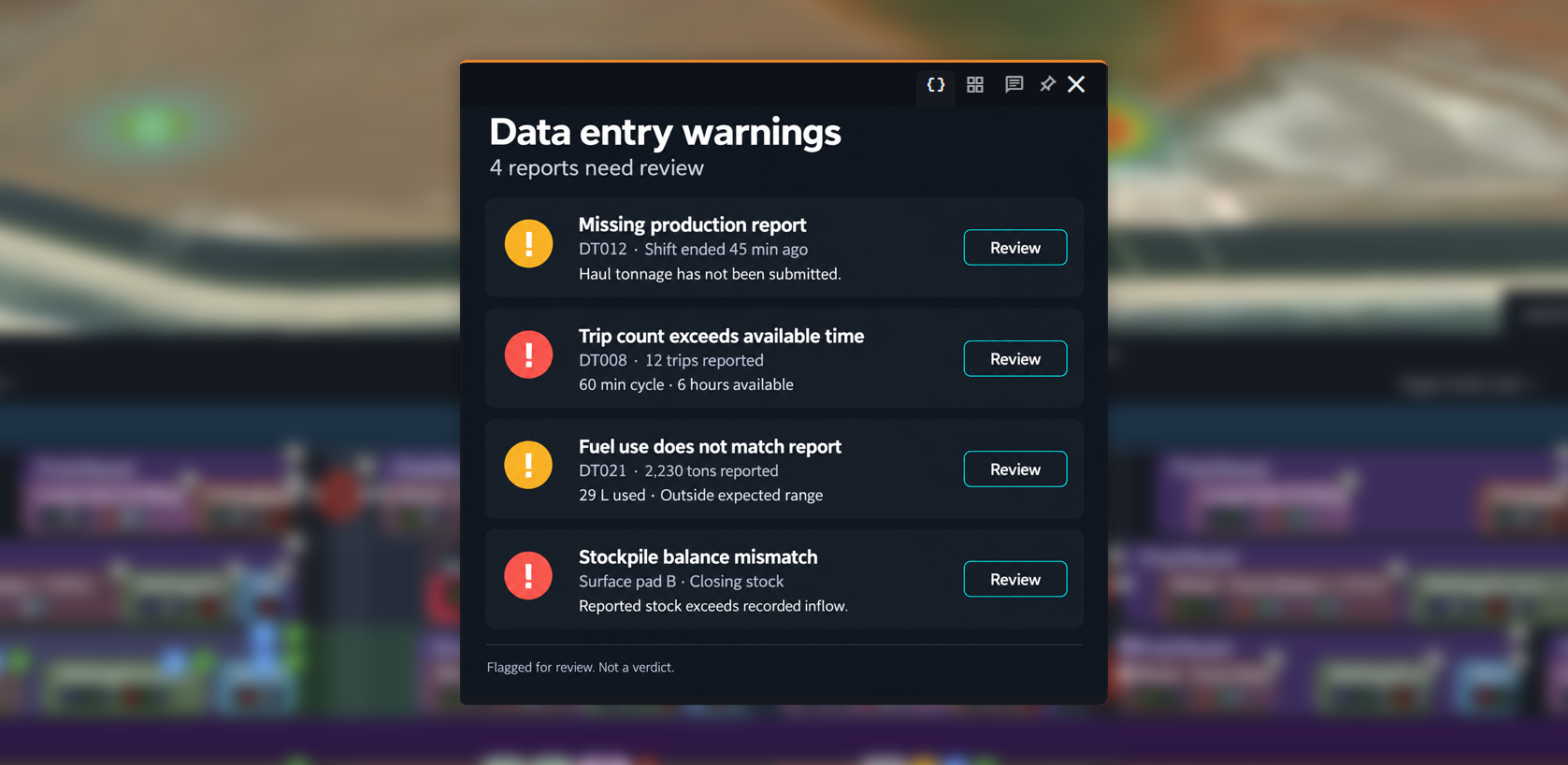 This is a bit of a delicate topic. Not all operations are equally trustworthy. On some sites, your crews are a well-oiled team that reports their tons, meters and trips to the second decimal point. And when surveyors go in later, everything is exactly as reported.
Then there’s the other kind of site.
Sometimes, reporting discipline is just low and operators don’t radio in their numbers. Sometimes, it’s more deliberate. Inflating or manipulating numbers can be in an individual’s best interest: to hide mistakes, cover up slacking or squeeze out a bit of extra bonus by overreporting haul trips.
That isn’t just bad for trust and morale. Feed those numbers into mine planning and you’re making real decisions based on fictional production.
But you don’t simply have to accept whatever is reported. If you already collect operational data, you can cross-check reports—all without installing expensive truck scales or having a supervisor watch every load.
Here’s how.
Know what numbers you’re expecting

The easiest way to hide a bad number is simply not to report it. It’s also one of the easiest problems to spot.
If you have a clear schedule of the shift’s activities, the people and vehicles assigned to them, and the metrics each activity requires, missing reports stand out.
“No number” shouldn’t quietly turn into “nothing to worry about.”
Check contextual feasibility
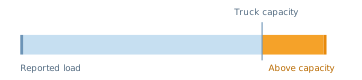
The first check on any number should be: “Is this possible at all?”
Could the truck carry the reported tonnage in the reported number of trips? Could it complete those trips in the available time, including loading, travel, unloading and queues? Could the excavator load that much material?
Twelve trips might sound reasonable. Twelve trips with an hour-long cycle time, completed during a six-hour shift, need an explanation.
Reconcile with contextual clues
Next, check whether other data supports the report.
An operator reports 12 trips and 2,230 tons. The truck started with 432 liters of fuel and finished with 403. That’s 29 liters used, assuming no refueling.
Does that fit the route, distance and truck’s usual consumption when empty and loaded?
Allow for idling, gradients and road conditions: fuel consumption depends on more than payload. Set tolerances using your own site data, rather than assuming a universal ±10%.
Fuel alone won’t prove a report is false. But fuel use, movement records and operating hours can reveal numbers that deserve a closer look.
Reconcile the production chain
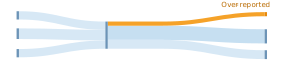 As your understanding of material movement improves, false reports become harder to hide.
Your heading dimensions and actual advance give you an estimated excavated volume. Local density gives you an estimated tonnage. That material should then appear in haul records, muck piles, surface pads or processing feeds.
For each stockpile, the logic is simple:
Opening stock + incoming material − outgoing material = closing stock.
Compare the same time periods and allow for measurement uncertainty, moisture and the volume change when rock is blasted.
If a crew reports hauling more material than was available, or a stockpile keeps growing without recorded deliveries, something doesn’t add up.
Detect statistical outliers
 Sometimes, a crew just has a really good day. It happens. But a driver or team consistently reporting production well above the usual range deserves a closer look.
Compare like with like: similar equipment, routes, materials and shift conditions. The question is whether the reported performance makes sense under those conditions.
Flag discrepancies before pointing fingers
An outlier is a reason to investigate. It isn’t a verdict. A typo, faulty sensor or delayed report can look suspicious too.
But repeated discrepancies deserve attention.
The goal is to build confidence in your numbers through consistent checks and reconciliations, with a reporting system that handles the routine verification automatically.
That way, honest work gets the credit—and fictional production doesn’t.